Investor relations
№ 004
An emerging manager has three audiences. None of them is a pension fund.
Most fundraising advice for emerging managers is written for the wrong audience. 🫣
The decks, the DDQ templates, the "what LPs want" checklists all picture the same buyer: a pension fund, an insurer, an endowment.
That buyer is real. It's just not who funds an emerging manager.
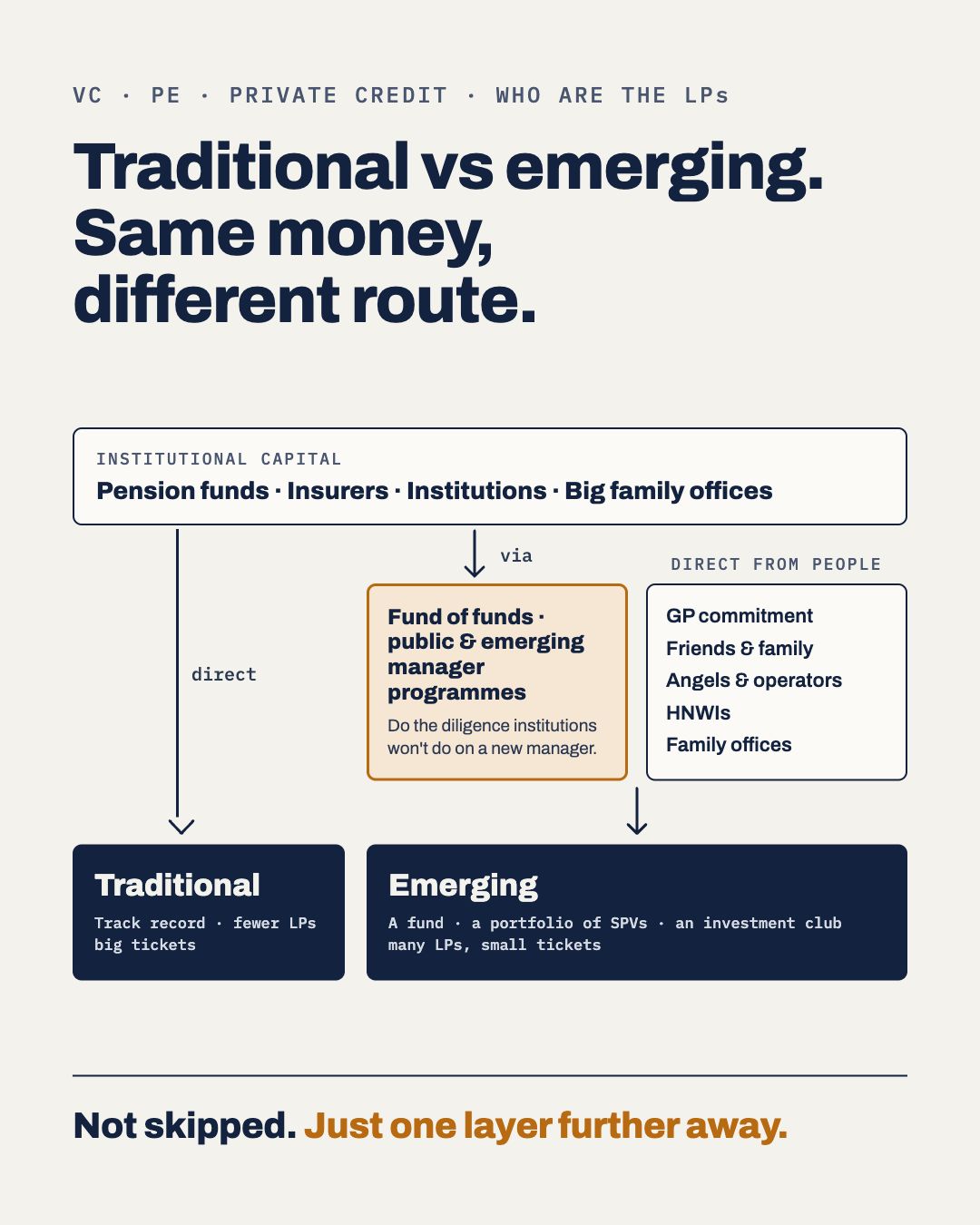
Whether it's VC, PE or private credit, the traditional manager's LP base looks like this:
→ Pension funds, insurers, institutions, endowments
→ Large family offices and fund of funds
→ A handful of LPs, big tickets, straight into the fund
An emerging manager's vehicle can be a fund, a portfolio of SPVs or an investment club. Its LP base looks like this:
→ The GP's own money
→ Friends & family, who back the person
→ Angels & operators, who back the thesis
→ HNWIs and family offices, who write the first real tickets
→ Fund of funds and emerging manager programmes, the only institutional money in the room
Institutions don't avoid emerging managers out of fear. It's arithmetic and process. 🚩
They want bigger checks than a small vehicle can absorb, and their investment committees need a track record to underwrite. PitchBook calls pensions and endowments "some of the most reluctant LPs" for first-time funds.
So when institutional money does reach emerging managers, it takes a detour.
Massachusetts PRIM set out to commit up to $1B to emerging managers, through five manager-of-managers. New Jersey's $250M programme is run by Barings. In emerging markets, first-time funds have historically been carried by development finance institutions, not commercial LPs.
Same money. One layer further away. ☝
That's the real lesson for IR: an emerging manager doesn't have one audience. It has three, and none of them is a pension fund.
→ Individuals buy the person. They want trust, access and reporting they actually read.
→ Family offices buy access. They want co-invest rights, deal flow and fast decisions.
→ Fund of funds buy process. They want a DDQ, institutional-grade reporting and policies on paper.
Pitch a family office like a pension fund and you sound like a bureaucrat. 🥸
Pitch a fund of funds like an angel and you sound like a hobbyist. 🤡
Most emerging managers copy the institutional playbook, talk to the wrong room, and wonder why nobody commits.
GPs: who wrote the first real check into your vehicle?
LPs: what made an emerging manager investable for you?